JC National Archives
  • Home
  • About Archives
    • About Us
    • Advocacy & Outreach
    • Frequent Questions
    • Policies and Procedures
    • Volunteer Opportunities
  • Online Collections
    • Agriculture
    • Buildings and Land
    • Communications
    • Defence and War
    • Dependencies
    • Falkland Islands Company Ltd Collection
    • Government
    • Health and Welfare
    • Mail, Stamps and Telecommunications
    • Natural History and Mineral Resources
    • People
    • Periodicals
    • Photographic Collections
    • Shipping
    • Trade and Industry
    • Utilities
  • Research Services
  • Contact Us

Stanley


Introduction

Richard Clement Moody, in his words “merely a subaltern of Engineers”, was chosen 22 July 1841 at the age of 28 to proceed to the Falkland Islands. Accompanied by a small but vital group of Royal Sappers and Miners and their families, as well as two civilians to undertake surveying, Moody arrived at Port Louis 15 January 1842. 

Only four days after his arrival Moody rode overland to inspect Port William in the company of Lieutenant Tyssen. After careful inspection he was of the opinion that it was much better adapted as the site of the chief town of the Colony than Port Louis but due to the lateness of the season did not have sufficient time to settle himself and his party before the winter commenced. 

Less than a month after his arrival Moody sailed around the Islands to gain an impression.  He completed his General Report 14 April and sent it on to London 3 May.  The report outlined the resources and potential of the Islands and raised again the question of the site of a new settlement, mentioning the Admiralty’s preference for Port William as a harbour over Berkeley Sound.    On 18 August 1843 Moody acknowledged the receipt of despatch 26 from Lord Stanley ordering him to take the necessary steps to remove the settlement to Port William as early as possible.  The first detachment of Sappers started work on the south shore of Jackson's Harbour August 1843 with the construction of a turf house and a small wooden house.  The move of the administration to Stanley - as Moody requested the new seat of government and future capital of the Falkland Islands be called - began in earnest during 1844 with the Governor himself finally moving to the new town on 15 July 1844.

GH_watercolour_-_FIC_JCNA.jpg

Watercolour of Government House & Offices probably circa 1845 – FIC Archives, JCNA

Research done on various buildings past and present in Stanley have been divided up into pages of various streets.  They are not a complete representation and are not necessarily a complete history but are intended to give a timeline for some of those that have been researched to date and will be added to from time to time.


Disclaimer

While every effort has been taken to ensure accuracy the Jane Cameron National Archives does not accept responsibility for any errors or omissions in these records.

Copyright guide

Copies of government records may be used freely for private research and educational purposes.  If material is to be used for commercial publication, exhibition or broadcast the written permission of the Jane Cameron National Archives must first be obtained. Whenever material from the Jane Cameron National Archives is reproduced in any form or in any medium, the user must acknowledge the Jane Cameron National Archives as the source and give all document references.  For non-government records it is your responsibility as the user to ensure that copyright is not infringed and any infringement that does occur is your responsibility.

Buildings Past and Present - Allardyce Street, Brandon Road, Dairy Paddock Road, Moody Street, King Street or McGill's Hill and St Mary's Walk


Introduction

Allardyce Street was named after Governor ALLARDYCE who was a very popular governor and devoted to the Falkland Islands.  Brandon Road was originally known as Dairy Paddock Road but was renamed in memory of the late Dean BRANDON in October 1933.  At that point it was approximately quarter of a mile long and ran from the Magazine Valley Road over a section of what was once a part of the Dairy Paddock to the Rose Hotel Hill. The original and current Dairy Paddock Roads were named after the dairy which the Falkland Islands Company Ltd used to have in the area.  Moody Street was named after Governor MOODY.  King Street, also known as McGill’s Hill after the McGill Butchery which was located there, was named after Commander Philip Parker KING who was the captain of the survey ship HMS Adventure.  St Mary’s Walk was named after the Roman Catholic Chapel.

Allardyce Street 15 June 1925

Allardyce Street looking west from the east side of King Street 15 June 1925

These files are not a complete representation of buildings past and present on these streets and are not necessarily a complete history but are intended to give a timeline for some of those that have been researched to date and will be added to from time to time.

Allardyce Street

pdf2 and 3 Allardyce Street Double house.pdf522.8 KB

pdf4 Allardyce Street.pdf226.36 KB

pdf14 Allardyce Street - Keva Cottage later Bennett House.pdf440.65 KB

Brandon Road

pdf7 Brandon Road West - Moody Street Hostel later Moody Street Flats.pdf511.97 KB

King Street

pdf2 King Street - Norwegian Bungalow.pdf467.11 KB

Moody Street

pdf8 Moody Street - Sunnymede Villa.pdf181.39 KB

St Mary's Walk

pdf5 St Marys Walk.pdf1.24 MB

pdf12 St Marys Walk - Douglas House later Scotia House.pdf322.56 KB

pdf14 St Marys Walk - Bungalow No 1.pdf343.6 KB

pdf16 St Marys Walk - Bungalow No 2.pdf519.2 KB


Disclaimer

While every effort has been taken to ensure accuracy the Jane Cameron National Archives does not accept responsibility for any errors or omissions in these records.

Copyright guide

Copies of government records may be used freely for private research and educational purposes.  If material is to be used for commercial publication, exhibition or broadcast the written permission of the Jane Cameron National Archives must first be obtained. Whenever material from the Jane Cameron National Archives is reproduced in any form or in any medium, the user must acknowledge the Jane Cameron National Archives as the source and give all document references.  For non-government records it is your responsibility as the user to ensure that copyright is not infringed and any infringement that does occur is your responsibility.

James Street, Hebe Street or Wang’s Hill, Hebe Place and Snake Hill


Introduction

James Street was probably named after Sir James Clark ROSS, the commander of HMS Erebus, part of the British Antarctic Expedition 1839 to 1843, and who called into the Falkland Islands in 1842.  He recommended Port William and its inner harbour as being the most advantageous anchorage for shipping.  Quite a number of the first buildings on this street were originally built of stone.  The plots to the north of James Street were originally fronted to the north by Ross Road East and backed to the south to what became James Street.  The original plots to the south of James Street ran to, and were fronted by, what is now Fitzroy Road East.  James Street was officially formed in 1889.

Hebe Street was named after the Brig Hebe, which arrived in the Falkland Islands in January 1842 with Lieutenant MOODY and his party of Sappers and Miners on board, and was formed in 1888.  It was known colloquially for a while as Wang’s Hill after the WANG family who lived in 3 Hebe Street.

Snake Hill was a descriptive name due to the winding nature of the road and first applied during World War II when the Snake Hill Military Camp was based to the north of what is now Kent Road.   

James Street showing houses north side 15 June 1925  

These files are not a complete representation of buildings past and present on these streets and are not necessarily a complete history but are intended to give a timeline for some of those that have been researched to date and will be added to from time to time.


James Street

pdf2 and 4 James Street.pdf683.21 KB

pdf5 James Street.pdf542.41 KB

pdf6 James Street.pdf585.18 KB

pdf7 James Street.pdf456.78 KB

pdf9 James Street.pdf839.08 KB

pdf10 James Street.pdf816.97 KB

pdf18 James Street.pdf2.6 MB

Hebe Street

pdf3 Hebe Street Stoney Cottage.pdf622.58 KB


Disclaimer

While every effort has been taken to ensure accuracy the Jane Cameron National Archives does not accept responsibility for any errors or omissions in these records.

Copyright guide

Copies of government records may be used freely for private research and educational purposes.  If material is to be used for commercial publication, exhibition or broadcast the written permission of the Jane Cameron National Archives must first be obtained. Whenever material from the Jane Cameron National Archives is reproduced in any form or in any medium, the user must acknowledge the Jane Cameron National Archives as the source and give all document references.  For non-government records it is your responsibility as the user to ensure that copyright is not inf ringed and any infringement that does occur is your responsibility.

Buildings and Land- General


Introduction

The following files include miscellaneous files on buildings and land in the Falkland Islands which don’t necessarily fit within one of the other categories and files which encompass more than one category.  They are not a complete representation of the information available in the Jane Cameron National Archives and are not necessarily a complete history but are intended to give an overview and may be added to from time to time.

The Land Registry books sustained fire, smoke and water damage during the Town Hall fire of 1944 and there is text missing/obscured in some of the books.  BUG-REG-2 is the worst damaged and therefore a transcription has also been uploaded.  BUG-REG-7 contains Leases, Powers of Attorney, Trade Marks, Wills and Naturalisations.

A number of the maps and plans are duplicated on other pages under their subject. 


Miscellaneous

pdfEarly Leases of Farm Land in the Falkland Islands.pdf3.02 MB

pdfList and Description of Government Property in the Colony 1848-1855 - E1.pdf19.56 MB

pdfAn Introduction to the History of Buildings in the Falkland Islands - Jane Cameron 1998.pdf342.77 KB

pdfTraditional Buildings of the Falkland Islands - Jane Cameron 2003.pdf966.6 KB


Land and Deeds Registers

pdfIndex to Series BUG-REG - Land Registers.pdf1.5 MB

pdfBUG-REG-1 Land Register Vol I - Part 1 - index to pg 41 - Dec 1847 to Jan 1847.pdf15.68 MB

pdfBUG-REG-1 Land Register Vol I - Part 2 - pg 42 to 165 - Apr 1847 to Feb 1857.pdf25.66 MB

pdfBUG-REG-1 Land Register Vol I - Part 3 - pg 166 to 285 - Jun 1857 to Jul 1865.pdf21.14 MB

pdfBUG-REG-1 Land Register Vol I - Part 4 - pg 286 to 401 - Sep 1865 to Apr 1875.pdf22.91 MB

pdfBUG-REG-2 - Leases incl Land Vol I - 1852-1883 - transcription of fire damaged volume.pdf6.72 MB

pdfBUG-REG-2 Land Register - Leases incl Land Vol I - Part 1 - index to pg 123 - Feb 1852 to Dec 1862.pdf17.18 MB

pdfBUG-REG-2 Land Register - Leases incl Land Vol I - Part 2 - pg 124 to 230 - Feb 1863 to Dec 1869.pdf19.67 MB

pdfBUG-REG-2 Land Register - Leases incl Land Vol I - Part 3 - pg 231 to 324 - Feb 1870 to Jul 1872.pdf20.84 MB

pdfBUG-REG-2 Land Register - Leases incl Land Vol I - Part 4 - pg 325 to 436 - Apr 1874 to Dec 1883.pdf21.99 MB

pdfBUG-REG-3 Land Register Vol II - Part 1 - index to pg 160 - Apr 1875 to Jun 1887.pdf24.98 MB

pdfBUG-REG-3 Land Register Vol II - Part 2 - pg 161 to 286 - Feb 1883 to Oct 1885.pdf18.86 MB

pdfBUG-REG-3 Land Register Vol II - Part 3 - pg 287 to 436 - Oct 1885 to Jun 1887.pdf23.84 MB

pdfBUG-REG-4 Land Register Vol III - Part 1 - index to pg 128 - May 1887 to May 1889.pdf20.91 MB

pdfBUG-REG-4 Land Register Vol III - Part 2 - pg 129 to 232 - Jun 1889 to Nov 1890.pdf14.22 MB

pdfBUG-REG-4 Land Register Vol III - Part 3 - pg 233 to 358 - Nov 1890 to Feb 1893.pdf18.71 MB

pdfBUG-REG-5 Land Register Vol IV - Part 1 - index to pg 128 - Mar 1893 to Mar 1896.pdf19.25 MB

pdfBUG-REG-5 Land Register Vol IV - Part 2 - pg 129 to 264 - Apr 1896 to Mar 1899.pdf17.86 MB

pdfBUG-REG-5 Land Register Vol IV - Part 3 - pg 265 to 358 - Apr 1899 to Jul 1901.pdf12.62 MB

pdfBUG-REG-6 Land Register Vol V - Part 1 - index to pg 116 - Aug 1901 to Sep 1904.pdf22.16 MB

pdfBUG-REG-6 Land Register Vol V - Part 2 - pg 117 to 302 - Oct 1904 to Apr 1908.pdf21.6 MB

pdfBUG-REG-6 Land Register Vol V - Part 3 - pg 303 to 402 - May 1908 to Jan 1911.pdf11.88 MB

pdfBUG-REG-7 Land Register Vol VI - Part 1 - index to pg 152 - Aug 1901 to Jan 1916.pdf20.78 MB

pdfBUG-REG-7 Land Register Vol VI - Part 2 - pg 153 to 402 - Feb 1916 to Dec 1932.pdf21.82 MB

pdfBUG-REG-8 Land Register Vol VII - Part 1 - index to pg 114 - Jan 1911 to Dec 1912.pdf15.75 MB

pdfBUG-REG-8 Land Register Vol VII - Part 2 - pg 115 to 282 - Jan 1913 to Jun 1919.pdf19.12 MB

pdfBUG-REG-8 Land Register Vol VII - Part 3 - pg 283 to 402 - Jul 1919 to Aug 1921.pdf12.25 MB


Planning Applications

pdfPlanning applications - 1950 to 1951.pdf15.1 MB

pdfPlanning applications - 1952 to 1953.pdf13.73 MB

pdfPlanning applications - 1954 to 1955.pdf13.1 MB

pdfPlanning applications - 1956 to 1957.pdf11.91 MB

pdfPlanning applications - 1958 to 1959.pdf14.88 MB

pdfPlanning applications - 1960 to 1962.pdf18.4 MB

pdfPlanning applications - 1963 to 1964.pdf14.95 MB

pdfPlanning applications - 1965 to 1967.pdf14.3 MB

pdfPlanning applications - 1968 to 1970.pdf14.17 MB

pdfPlanning applications - 1971 to 1972.pdf9.87 MB


Maps and Plans

 Admiralty Charts

pdfAdmiralty Charts - 19th Century.pdf5.61 MB

pdfAdmiralty Charts - 20th Century.pdf4.48 MB

pdfAdmiralty Charts - 21st Century.pdf1.65 MB


Stanley - Buildings

pdfAdmiralty Cable Station.pdf1.85 MB

pdfAdmiralty Cottage.pdf287.31 KB

pdfBuildings - General.pdf11.55 MB

pdfCable and Wireless.pdf857.23 KB

pdfChrist Church Cathedral.pdf7.53 MB

pdfDeanery.pdf471.94 KB

pdfDockyard.pdf3.71 MB

pdfEuropean Space Research Station - ESRO.pdf11.59 MB

pdfGovernment School.pdf5.74 MB

pdfHospital.pdf6.38 MB

pdfInfant Junior School.pdf1.36 MB

pdfIonespheric Station.pdf935.01 KB

pdfKorean Seamens Club.pdf1.26 MB

pdfLibrary and Museum.pdf1.52 MB

pdfMeteorological.pdf2.78 MB

pdfPolice Station and Gaol.pdf2.25 MB

pdfPublic Baths and Gymnasium.pdf5.53 MB

pdfQuarantine Station.pdf943.64 KB

pdfSchool hostel.pdf7.92 MB

pdfSecretariat.pdf3.93 MB

pdfSulivan House.pdf4.13 MB

pdfSwimming pool.pdf2.24 MB

pdfTown Hall.pdf4.56 MB

pdfWireless Telegraphy Stations.pdf2.46 MB


Stanley – Other

pdfCrown Grants.pdf14.87 MB

pdfOutskirts.pdf2.82 MB

pdfPeat Banks.pdf14.06 MB

pdfRoads and Buildings.pdf16.79 MB

pdfStanley Cemetery.pdf2.58 MB


Farming

pdfAjax Bay Abattoir.pdf7.46 MB

pdfDarwin Boarding School.pdf4.24 MB

pdfFarming - Darwin.pdf1.04 MB

pdfFarming - Douglas Station.pdf6.23 MB

pdfFarming - Farm Boundaries.pdf6.74 MB

pdfFarming - Fox Bay East.pdf3.39 MB

pdfFarming - Goose Green.pdf558.67 KB

pdfFarming - Hill Cove.pdf10.23 MB

pdfFarming - Miscellaneous Farms.pdf3.13 MB

pdfFarming - Port Louis.pdf4.17 MB

pdfFarming - Port San Carlos.pdf2.9 MB


Gazetteer 2024

The following were first published in the Falkland Islands Journal. Copyright belongs to Robin Isherwood.

xlsGazetteer 2024.xls1.78 MB

xlsGazetteer 2024 in data filter format.xls1.79 MB

xlsDirectorate of Overseas Surveys sheets used for Gazetteer 2024.xls30.00 KB

xlsGazetteer 2024 sheet grid coordinates.xls48.00 KB

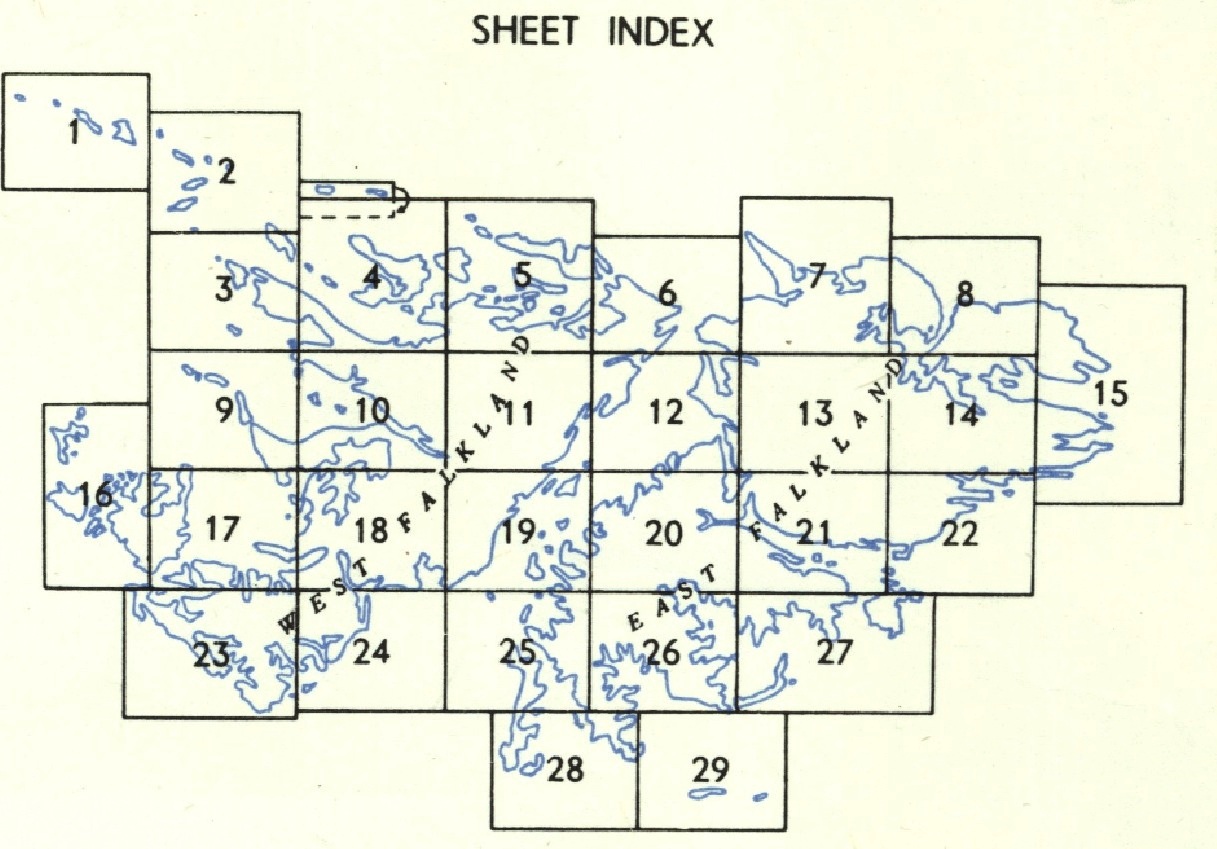
jpgGazetteer 2024 sheet index.jpg243.86 KB


Sheet Series

pdfSeries H791 - 1961 and 1962.pdf8.02 MB

pdfSeries H791 - 1982.pdf8.18 MB

pdfSeries 5460 - 1982.pdf1.44 MB

pdfSeries DOS 653 - 1995.pdf655.44 KB 

pdfSeries GSGS 5460 - 1996.pdf1.29 MB


Other

pdfAerosurvey.pdf1.29 MB

pdfMiscellaneous.pdf2.47 MB


Disclaimer

While every effort has been taken to ensure accuracy the Jane Cameron National Archives does not accept responsibility for any errors or omissions in these records.

Copyright guide

Copies of government records may be used freely for private research and educational purposes.  If material is to be used for commercial publication, exhibition or broadcast the written permission of the Jane Cameron National Archives must first be obtained. Whenever material from the Jane Cameron National Archives is reproduced in any form or in any medium, the user must acknowledge the Jane Cameron National Archives as the source and give all document references.  For non-government records it is your responsibility as the user to ensure that copyright is not infringed and any infringement that does occur is your responsibility.

Islands

Introduction

Life in the early days was hard in the Falkland Islands. Life on the outer islands was even harder with even more isolation than those on East and West Falkland experienced and for some of the more remote islands the inhabitants would go months without seeing other people. The mail service could be sporadic and the cost of getting their produce to the market expensive. The seas were rough and the coastlines hazardous and many of the islands have the remains of shipwrecks still visible. With Stanley Cemetery being a long, risky sea voyage in small cutters many of the outlying islands have their own cemeteries.

The majority of buildings in the Falkland Islands are now constructed of wood. In the early days quite a number of buildings were constructed from local stone and although there are a number of stone buildings still around the Islands it is not a popular building material as the local grey stone is very dense and difficult to dress while the sandstone, or Fox Bay stone as it is known locally, is only suitable for cladding and paving.  With the remoteness of some of the outer islands and the cost and logistics of shipping building materials to them it was not uncommon in the early days for buildings and fences to be constructed from wood salvaged from nearby wrecks and from driftwood washed ashore.

These files are not a complete representation of Island settlements in the Falkland Islands and are not necessarily a complete history but are intended to give an idea of some of the more well-known and may be added to from time to time.


pdfBeaver Island Governor Island Staats Island and Green Island.pdf457.89 KB

pdfBleaker or Long or Breaker Island.pdf1.65 MB

pdfCarcass Island Dunbar Island Low Island and the Twins.pdf689.61 KB

pdfJason Islands.pdf1.06 MB

pdfLively or Volunteer or Mackays Island Philimore Is Philimore Chico Middle Is North East Is Green Is Kidney Is Reef Is Irene Is Cow Is Gull Is.pdf427.78 KB

pdfNew Island Saddle Island Coffin Island Tigre Harbour.pdf1 MB

pdfPassage Islands.pdf638.18 KB

pdfPebble Island West Pebble Island Golding Island Broken Island East Island Narrow Island and Middle Island etc.pdf420.04 KB

pdfSaunders Island.pdf317.19 KB

pdfSea Lion Island.pdf2.03 MB

pdfSpeedwell or Eagle Island George Island and Barren Island.pdf829.57 KB

pdfWeddell or Swan Island.pdf1.46 MB

pdfWest Point or Albatross Island or Clifton Station.pdf774.74 KB


Disclaimer

While every effort has been taken to ensure accuracy the Jane Cameron National Archives does not accept responsibility for any errors or omissions in these records.

Copyright guide

Copies of government records may be used freely for private research and educational purposes. If material is to be used for commercial publication, exhibition or broadcast the written permission of the Jane Cameron National Archives must first be obtained. Whenever material from the Jane Cameron National Archives is reproduced in any form or in any medium, the user must acknowledge the Jane Cameron National Archives as the source and give all document references. For non-government records it is your responsibility as the user to ensure that copyright is not infringed and any infringement that does occur is your responsibility.
  1. Buildings Past and Present - Ross Road, Crozier Place, Reservoir Road and Racecourse Road
  2. Buildings Past and Present - Brisbane Road and Villiers Street
  3. Buildings Past and Present - Barrack Street, Drury Street and Pioneer Row

Subcategories

West Falkland

East Falkland

Copies of government records may be used freely for private research and educational purposes. If material is to be used for commercial publication, exhibition or broadcast the written permission of the Jane Cameron National Archives must first be obtained. Whenever material from the Jane Cameron National Archives is reproduced in any form or in any medium, the user must acknowledge the Jane Cameron National Archives as the source and give all document references. For non-government records it is your responsibility as the user to ensure that copyright is not infringed and any infringement that does occur is your responsibility.
© 2026 Jane Cameron National Archives

Contact Us

Jane Cameron National Archives
Jeremy Moore Avenue
P.O. Box 579
Stanley, Falkland Islands
FIQQ 1ZZ

Email: national.archives@sec.gov.fk
Tel: +500 27249

  • Home
  • About Archives
    • About Us
    • Advocacy & Outreach
    • Frequent Questions
    • Policies and Procedures
    • Volunteer Opportunities
  • Online Collections
    • Agriculture
    • Buildings and Land
    • Communications
    • Defence and War
    • Dependencies
    • Falkland Islands Company Ltd Collection
    • Government
    • Health and Welfare
    • Mail, Stamps and Telecommunications
    • Natural History and Mineral Resources
    • People
    • Periodicals
    • Photographic Collections
    • Shipping
    • Trade and Industry
    • Utilities
  • Research Services
  • Contact Us
    • 1877 to 1899 (H34 to H50)
  • Agriculture
    • Treasury